

Gene Inspector starts with Findings. Each report answers a different question about your DNA. You can open a gene from a report and then inspect one DNA change at a time. The app calls a difference from a standard DNA sequence a variant.
Start from Findings
Open Findings in your genome. Reported in ClinVar shows DNA changes with submitted classifications about health conditions. Variants predicted to affect protein function looks more broadly and can include changes without a ClinVar classification. Its computer scores estimate possible effects on proteins. A score cannot confirm an effect on your health.
Choose a report, then select a gene to open its Gene page. The page shows what the gene does, which DNA changes appear in your file, and details about each change.
Read one DNA result
This screenshot shows a result from the public demo genome. The numbers point to the parts you will see in a variant row and its details panel.
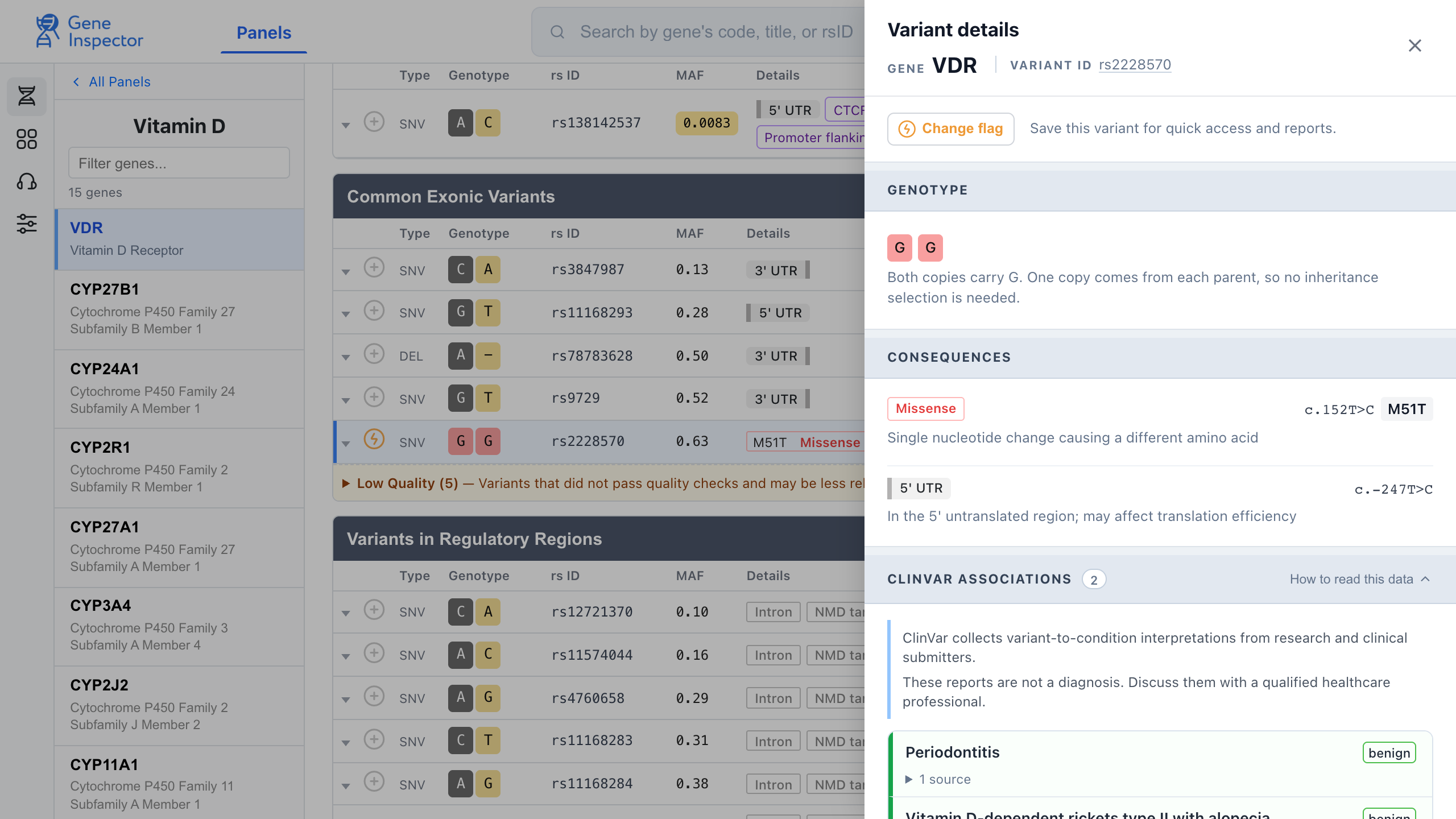
- DNA letters and color: The two G letters are the two copies shown at this position. Red means both differ from the standard sequence. Red does not mean dangerous.
- rs ID: rs2228570 is a database label for this DNA change. It helps you find the same change in a public reference. The label alone says nothing about health risk.
- Result details: Missense describes a change that alters one building block in a protein. It does not prove that the protein works differently or that your health is affected.
- Public reference link: The underlined variant ID in the details panel opens a public record. Check the record and its evidence before drawing conclusions.
Gene information
Most genes have a short code and a full name. For example, VDR is the gene code for Vitamin D Receptor. Gene Inspector shows both names at the top of the page, followed by a short description of the gene.

The GeneCards link opens an external reference page for the same gene. If Gene Inspector has associated pathology data, it lists diseases connected to known gene dysfunction. This list is context, not a diagnosis.
Gene Inspector does not diagnose disease from an uploaded DNA file. Use the information as review support and discuss clinical questions with a licensed clinician.
Some diseases require changes in both gene copies, which is called autosomal recessive inheritance. Others can be caused by a change in one copy, which is called autosomal dominant inheritance.
Variant list
The All Detected Variants tab lists DNA changes found in the uploaded genome for that gene. Gene Inspector groups them by where they occur and what they may affect. The Researched Variants tab shows changes linked to research findings.
Minor allele frequency is shown as a decimal from 0 to 1. It estimates how often the variant appears in population datasets.
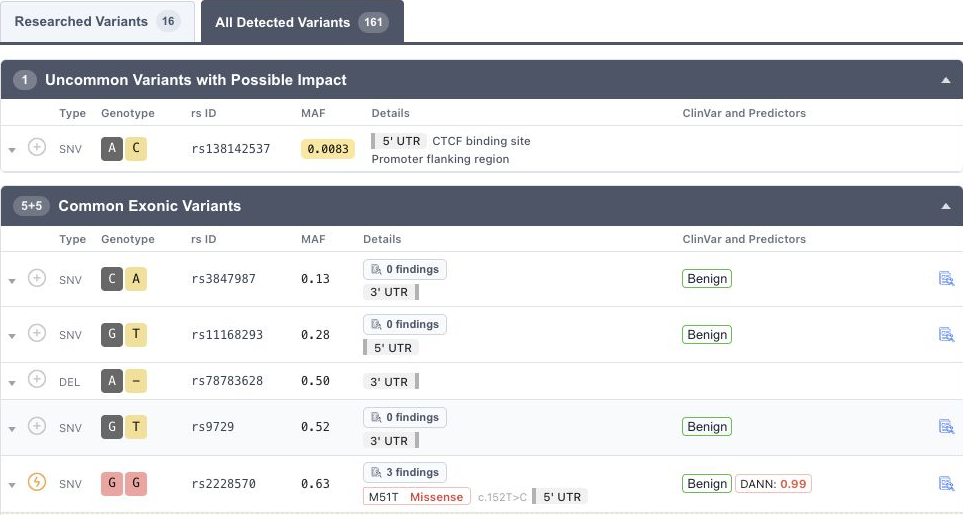
In this example, the result labeled rs138142537 shows the DNA letters A and C and a frequency estimate of 0.0083. The yellow letter means one copy differs from the standard sequence. The red G/G result farther down means both copies differ. Neither the color nor the frequency tells you whether a DNA change is harmful.
Variant details
A review mark appears as an orange line and icon. You can add or remove a mark when a variant needs follow-up.
The Type column describes the variant class. SNV means single nucleotide variant, a change in one DNA letter. INS means insertion. DEL means deletion.
Genotype
The genotype column shows the DNA letters in the uploaded file. Most results show two copies of each position. A dark letter matches the standard sequence used for comparison. When both copies match, both letters are dark. Yellow means one copy differs. Red means both copies differ. Some positions show only one copy; there, red means that copy differs. These colors describe the DNA call. They do not show whether a change is harmful.
The current VDR variant-list image above shows dark, yellow, and red genotype letters.
Reference SNP ID
The rs ID column links to dbSNP records when a public record exists. An rs ID is a lookup label, not a health score. A DNA change can have no rs ID and still be real.
Consequence and predictor scores
The details column describes the possible effect of a DNA change on a gene. Common terms include intron, missense, frameshift, stop gained, and stop lost. Some changes also have computer scores such as SIFT, AlphaMissense, or DANN. A score is a prediction. It does not confirm a health effect.
ClinVar classifications
ClinVar stores submitted classifications about a DNA change and a specific condition. Pathogenic and likely pathogenic are formal classification labels. They describe the reported change and condition; they are not a personal diagnosis. Reports can differ, so check the source and review status.